

Knee Replacement Diet Plan: What to Eat Before (Pre-hab) and After Surgery?
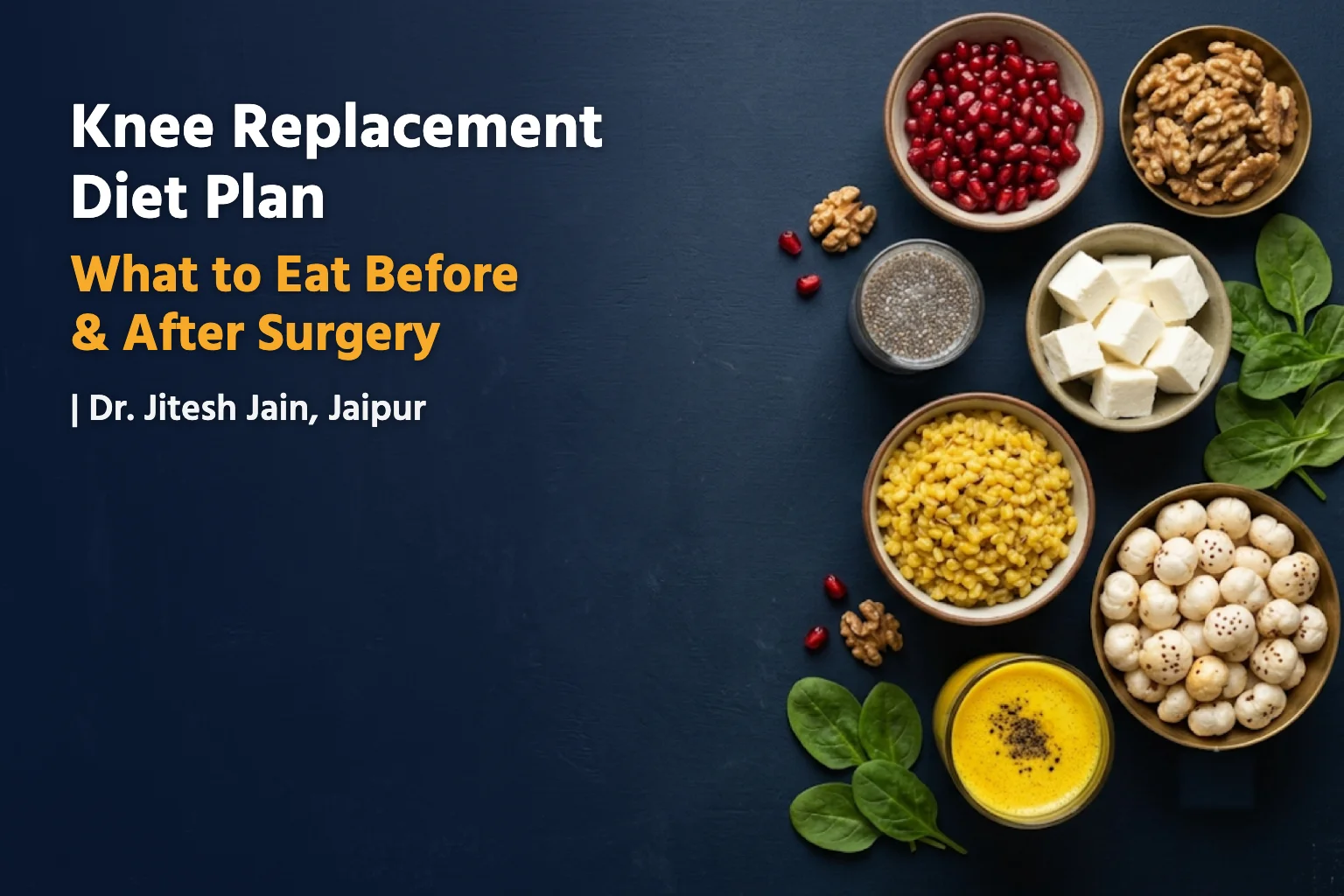
Diet Before Knee Replacement Surgery (Pre-hab Diet): The Science of Faster and Better Recovery
Patients often ask me why some people start walking within weeks after knee replacement, while others take months to recover fully. The biggest reason is not only the surgical technique, but the inner preparation of the body before surgery, which we call 'Pre-hab'.
Surgery is like a big shock (trauma) for the body. Right after surgery, the body goes into a 'Catabolic State'. This means that to make up for the shortage of energy, the body starts using the protein stored in the muscles, and the muscles start getting weak very fast (muscle loss).
Along with this, because of the swelling in the joint, the brain stops the muscles from working, and the body develops 'Anabolic Resistance'. That means no matter how much high-protein food you eat, your cells are simply not able to absorb that protein. This is why taking only protein powder after surgery is not enough.
💬 Chat on WhatsAppWhy Do the Muscles Become Weak So Quickly? (Two Main Reasons)
A common question from patients after surgery is, "Why does my leg look so thin and weak?" There are two big scientific reasons behind this, and recovery is incomplete without understanding them:
1. Weakness from not using the leg (Disuse Atrophy): Because of knee pain before surgery, and because of rest after surgery, we don't use the leg much. It is the rule of nature that "the part of the body which is not used, the body makes it weak." When muscles don't work, they quickly start shrinking and getting thin. In medical language this is called 'Disuse Atrophy'.
2. The brain stops sending signals to the muscles (Arthrogenic Muscle Inhibition, AMI): This is the most important reason. After surgery there is swelling and pain inside the knee. Because of this swelling, our brain adopts a 'Defense Mechanism' and reduces the current or signal going to the main thigh muscles (Quadriceps). That means your muscles become sort of numb. Even if you want to, you cannot lift your leg with full strength. This is called AMI.
This is why normal protein is not enough! When the brain is not giving signals to the muscles and the muscles are shrinking, just eating dal or normal protein is not sufficient. We need a special medical diet and nutraceuticals (HMB, EAAs, Creatine, Ashwagandha, Turmeric) which:
- reduce the body's inflammation quickly, so that the brain's signal can switch on again;
- stop muscle loss even without heavy exercise (this is the work of HMB);
- deliver protein directly to the cells so that new strength can be built.
To make recovery faster, we need a holistic approach: stop the breakdown of muscles, replace the damaged mitochondria (the powerhouse of the cells) with new ones, reduce inflammation, and open the doors of the cells so that nutrients can go inside.
Which Nutrients Are Needed, and How to Get Them From Your Diet?
Opening the doors of the cells (Cell Permeability)
After surgery the cells become stiff. Omega-3 fatty acids make the outer layer of the cells flexible, so that they can absorb amino acids easily.
- Diet sources: Chia seeds (soak overnight and take in the morning), walnuts, flaxseeds and fatty fish (salmon).
Stopping muscle breakdown (Anti-Catabolic) and building muscle (Anabolic)
To stop muscle loss, the body needs Essential Amino Acids (EAAs), Leucine and especially HMB.
- Sources of Leucine and EAAs: Milk, paneer, soya, eggs and dals.
- The truth about HMB: HMB is the most powerful element for stopping muscle breakdown. But it is present in such small amounts in grapes, lemon and catfish that to get the clinical dose (3 grams) you would have to eat many kilos of food.
Cleaning out old cells and new energy (Mitochondrial Repair)
After surgery, old and damaged cells hold back recovery. 'Urolithin A' removes damaged mitochondria and makes new ones, and 'Creatine' gives them instant energy.
- Sources of Urolithin A: It is not present directly in food. When you eat pomegranate, berries and walnuts, the good bacteria in your stomach (gut flora) make it.
- Sources of Creatine: Red meat and fish. In a vegetarian diet, creatine is almost zero.
Reducing swelling and relieving pain (Herbal Anti-inflammatory)
To reduce the stress of surgery and the cortisol hormone, and to bring down swelling in a natural way, the elements of Ayurveda are unmatched.
- Ashwagandha: It reduces the stress hormone (Cortisol), which stops muscle loss. It can be taken at night with warm milk.
- Turmeric (Curcuma Longa): The curcumin in turmeric stops inflammation naturally. Always take it with black pepper and a little ghee/fat, so that the body can absorb it.
- Hadjod (Cissus Quadrangularis): It speeds up the healing of bones and ligaments. Its supplement or juice can be used.
Strength of the bones (Vitamins D3 & K2)
The combination of these two is necessary to take calcium out of the blood and deliver it to the right place (the bones).
- Diet sources: Morning sunlight (the best source of D3), milk, and green leafy vegetables.
The Truth About Diet: Why Do We Need Supplements (Nutraceuticals)?
Increasing pomegranate, chia seeds, walnuts, milk, paneer and turmeric in your diet 3 to 4 weeks before surgery is very beneficial. It reduces the body's baseline inflammation (swelling).
But the truth of medical science is that for a big recovery like surgery, the body needs a 'clinical dose' of these elements. For example, getting 500 mg of Urolithin A or 3000 mg of HMB from normal food alone is practically impossible for the human body.
So the best strategy is to take a pure, balanced and natural anti-inflammatory diet (green vegetables, fruits, dry fruits, good fats), and to use a high-quality clinical 'Nutraceutical' a few weeks before and after surgery which has EAAs, HMB, Creatine, Urolithin A and Omega-3 in the right amounts. This combination can cut your recovery time in half and bring you back to a pain-free, active life quickly.
Ideal Diet Chart for Faster Recovery (Pre-hab & Post-Surgery)
This diet chart is made especially to give the body protein, omega-3, antioxidants and the elements that reduce swelling.
As soon as you wake up (empty stomach): Hydration and cellular health
- What to take: 1 tablespoon chia seeds / flaxseeds (soaked in water overnight) and 5-6 soaked walnuts.
- Benefit: Chia seeds give plenty of omega-3 (which will open the doors of the cells), and walnuts give the raw material for 'Urolithin A' (which will remove old mitochondria and give new energy).
Breakfast (8:30 - 9:00 AM): High protein and energy
- What to take: 2 moong dal cheelas, or paneer bhurji (about 100 grams of paneer), or soya poha. Along with a bowl of curd.
- Benefit: This gives the body plenty of amino acids (EAAs) right at the start of the day, which will start the recovery.
Mid-morning snack (11:00 AM): Antioxidant boost
- What to take: 1 bowl of fresh pomegranate, or 1 glass of unstrained pomegranate juice.
- Benefit: Pomegranate is the most important food for making 'Urolithin A', which removes muscle fatigue and brings new life.
Lunch (1:00 - 1:30 PM): Balanced meal
- What to take: 2 rotis (multigrain), 1 big bowl of thick dal (arhar/moong/chana), 1 bowl of green vegetable (spinach/broccoli/methi), and fresh salad.
- Benefit: Dals give the necessary protein, and vegetables give vitamins (especially Vitamin K), which will help join the bones and ligaments.
Evening snack (4:30 - 5:00 PM): Anti-inflammatory
- What to take: Roasted makhana or roasted chana. Along with green tea or chamomile tea.
- Benefit: Makhana is good for the bones, and this light snack gives energy without making the body heavy.
Dinner (7:30 - 8:00 PM): Recovery meal
- What to take: Soyabean chunks sabzi, or dal khichdi, or tofu/paneer. The food should be light but full of protein.
Before sleeping (Night Recovery Drink)
- What to take: 1 glass of warm milk with half a teaspoon of pure turmeric, a pinch of black pepper (black pepper helps the body absorb turmeric 2000% more), and Ashwagandha (as advised by the doctor).
- Benefit: The body does the most recovery while sleeping. Ashwagandha will reduce cortisol (the stress hormone), and turmeric will naturally reduce the swelling (AMI) after surgery.
Note: Along with this, take the clinical nutraceutical supplements advised by the doctor (containing HMB, EAAs, Creatine etc.) on time, because the 100% medical dose of these cannot be completed through diet.
When to Start This Diet and How Long to Continue?
- Before surgery (Pre-hab): Start this diet and the supplements at least 3 to 4 weeks before surgery. This will make the body's baseline nutrition strong, and the body will be ready to bear the shock of surgery. Also see my knee replacement preparation checklist.
- After surgery (Post-hab): Follow it strictly for at least 8 to 12 weeks after surgery. This is the time when your new muscles are taking shape and the knee is getting its full strength back. Diet works best together with the right exercises after knee replacement.
Watch: Preparing for Knee Replacement (Hindi)
Dr. Jitesh Jain explains what to take care of before knee replacement surgery (in Hindi).
Watch: Care After Knee Replacement (Hindi)
Dr. Jitesh Jain on care after knee replacement surgery (in Hindi). More tips: knee replacement post-care.
With this holistic diet and the right supplements, you will be able to stand on your feet much faster and with less pain compared to other patients!
HAPPY RECOVERY!!
Frequently Asked Questions (FAQs)
When should I start the diet before knee replacement?
Start this diet and the supplements at least 3 to 4 weeks before surgery. This makes the body's baseline nutrition strong, and the body is ready to bear the shock of surgery.
How long should I follow this diet after knee replacement?
Follow it strictly for at least 8 to 12 weeks after surgery. This is the time when your new muscles are taking shape and the knee is getting its full strength back.
Is protein powder enough after knee replacement?
No. After surgery the body develops 'Anabolic Resistance', so no matter how much high-protein food you eat, the cells are not able to absorb that protein properly. The swelling also stops the brain from sending full signals to the thigh muscles (AMI). You need a diet that reduces inflammation, along with the right nutrients like EAAs, HMB, Creatine and Omega-3.
Why does my leg look thin and weak after knee replacement?
There are two reasons. First, Disuse Atrophy: because of pain before surgery and rest after surgery, the leg is not used much, and unused muscles shrink. Second, Arthrogenic Muscle Inhibition (AMI): the swelling inside the knee makes the brain reduce the signal to the Quadriceps, so you cannot lift the leg with full strength.
Can I get all these nutrients from food alone?
A good diet helps a lot, but for a big recovery like surgery the body needs a clinical dose. For example, 500 mg of Urolithin A or 3000 mg of HMB from normal food alone is practically impossible. So take a natural anti-inflammatory diet along with the clinical nutraceutical advised by your doctor.
What should I drink at night after knee replacement?
1 glass of warm milk with half a teaspoon of pure turmeric, a pinch of black pepper, and Ashwagandha as advised by the doctor. Ashwagandha reduces cortisol, and turmeric naturally reduces the swelling after surgery.
Can I get diet advice before my knee replacement in Jaipur?
Yes. I guide my knee replacement patients at Rajasthan Hospital, Jaipur on pre-hab diet, supplements and exercises before surgery. You can send your query on WhatsApp; the first WhatsApp consultation is free.
Planning Your Knee Replacement?
Good preparation before surgery makes a big difference to how fast you get back on your feet. If you are planning a robotic knee replacement in Jaipur (read my knee replacement recovery journey), send me your query on WhatsApp and my team will guide you on the pre-hab diet, supplements and exercises for your case.
💬 Chat on WhatsAppयह लेख हिंदी में पढ़ें: नी रिप्लेसमेंट डाइट प्लान: सर्जरी से पहले और बाद में क्या खाएं?